
Master Learning Experience Design for Engaging Training
Let's get one thing straight: Learning Experience Design (LXD) isn't just a fancy new term for training. It's a complete shift in philosophy. It’s the art and science of creating learning that is human, goal-driven, and genuinely engaging.
Think about the difference between a dry, dusty textbook and a hands-on museum exhibit. Both have the same information, right? But only one creates a memorable experience that actually sticks with you. That’s LXD in a nutshell.
A Better Way to Learn
We've all been there. Sitting through traditional training that feels like a lecture on repeat. Information gets thrown at you, you’re expected to soak it up, and success is a simple pass or fail on a quiz. This old-school, content-first approach is like a chef who obsesses over the ingredients but couldn't care less about the flavor, presentation, or if you even enjoyed the meal.
Learning experience design completely flips that script. It starts and ends with one person: the learner.
Drawing heavily from the world of User Experience (UX) design, LXD is all about empathy. It digs deep to understand the learner’s world—their motivations, their daily challenges, and their ultimate goals. It forces us to ask the important questions: Who are we designing this for? What do they already know? What's standing in their way? And what does success really look like for them?
This fundamental shift from being content-focused to learner-focused is what makes learning experience design so powerful.
From Passive Observer to Active Participant
The real goal of LXD is to stop treating people like empty vessels waiting to be filled with information. It's about turning them into active drivers of their own learning journey. This means creating a complete experience that isn't just informative but also intuitive, motivating, and personally meaningful.
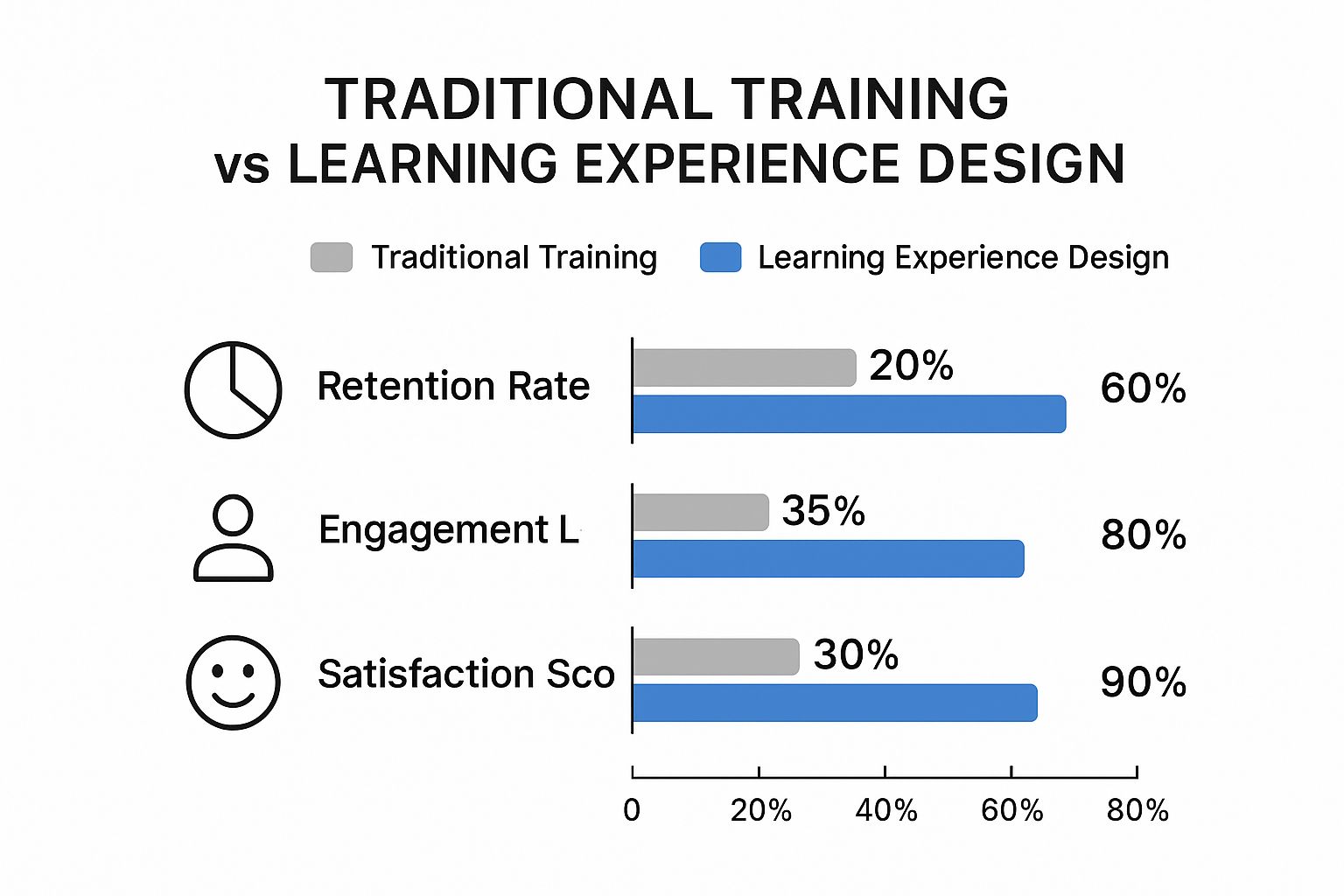
The difference in outcomes is staggering.
 Image
Image
As you can see, when you design for the human on the other side of the screen, metrics like retention and engagement go through the roof. It's not just a nice idea; it's a business imperative. This focus on the learner is fueling massive industry investment. The Learning Experience Platform (LXP) market was valued at USD 2.1 billion in 2023 and is on track to explode to nearly USD 28.9 billion by 2032. You can dig into the full market projections to see just how serious companies are about getting this right.
Traditional Design vs Learning Experience Design
The table below breaks down the fundamental shift in thinking between the old way and the new way. It highlights how LXD re-centers the entire process around the person, not just the material.
| Aspect | Traditional Instructional Design | Learning Experience Design (LXD) |
|---|---|---|
| Primary Focus | Content delivery & information transfer | The learner's journey & overall experience |
| Starting Point | "What content needs to be covered?" | "Who is the learner and what do they need?" |
| Learner's Role | Passive recipient | Active participant |
| Key Metric | Completion rates & test scores | Engagement, application & performance improvement |
| Design Process | Linear and standardized | Iterative, empathetic, and user-tested |
| Analogy | A lecture or a textbook | A guided discovery or a simulation |
Ultimately, LXD moves us away from simply checking boxes and toward building real-world skills and confidence.
At its heart, learning experience design is a commitment to empathy. It’s about stepping into the learner’s shoes to build a path that is not just educational, but also empowering and enjoyable.
This modern approach ensures that every single element—from the look and feel of the interface to the activities themselves—works in harmony to help the learner succeed. It's about building skills, improving performance, and maybe, just maybe, fostering a genuine love of learning along the way.
The Core Principles of Effective LXD
 Image
Image
To really get learning experience design, we have to look past the textbook definition and dig into the pillars that give it its power. These aren't just abstract ideas; they're the practical, guiding forces that turn a generic training module into something memorable and genuinely impactful.
Think of them as the constitution for creating great learning. Each principle works with the others, making sure the final product is cohesive, relevant, and built from the ground up for the learner’s success.
Let's break down these essential pillars.
Start with Empathy: A Human-Centered Approach
The absolute bedrock of LXD is its relentless focus on the person. A human-centered approach means every single design choice starts and ends with the learner. We're constantly thinking about their needs, their context, and even their emotions. We ask questions like, "What are their biggest headaches at work?" and "What actually gets them excited to learn something new?"
It’s the difference between buying a suit off the rack and getting one custom-tailored. The off-the-rack suit might be fine, but the tailored one is built just for you, accounting for every detail. LXD is the master tailor of learning—it ensures the experience fits the individual, not the other way around. This deep sense of empathy is what separates good design from truly great design.
This human-first mindset is precisely why companies are pouring money into better digital learning. The e-learning services market hit a value of USD 313.65 billion in 2024 and is on track to reach an incredible USD 2.04 trillion by 2034. A huge chunk of that growth—especially in North America, which holds 38% of the market—comes from the demand for training that feels personal and actually works. You can dive deeper into the numbers in the full e-learning market report.
Design with a Destination: Goal-Oriented Design
Real learning isn’t just a random walk; it’s a journey with a purpose. Goal-oriented design makes sure every single piece of the experience—every module, every activity, every assessment—is directly tied to a clear and well-defined learning objective.
It’s just like planning a road trip. You don't just get in the car and start driving. You pick a destination first. Then you map the best route, plan your stops, and figure out what to pack. In LXD, that "destination" is the specific skill or piece of knowledge the learner needs to walk away with.
A learning experience without a clear goal is like a ship without a rudder. It might be moving, but it's not heading toward a meaningful destination. The learner feels adrift, and the organization sees no measurable impact.
This principle forces designers to be ruthless about efficiency. If something doesn't serve the ultimate goal, it gets cut. This ensures the learner’s time and effort are always respected and pointed toward a valuable outcome.
Iterate and Improve: Data-Driven Design
So, how do you know if your beautiful design is actually working? You listen to the data. Data-driven design is all about collecting feedback and performance metrics to constantly refine and improve the learning experience. It’s how you turn your best guesses into certainties.
Think of a chef tasting a soup while it simmers. They don't wait until it’s on the table to see if it needs more salt. They taste, adjust, and taste again until it's just right. LXD uses data from quizzes, user feedback, and analytics as its tasting spoon.
This iterative loop often involves:
- A/B Testing: Trying out two versions of a quiz or activity to see which one gets better results.
- Analyzing Engagement: Pinpointing where learners are dropping off or what content they keep coming back to.
- Soliciting Feedback: Using simple surveys and interviews to understand what the experience felt like for the learner.
By embracing this cycle of feedback and iteration, we can fix what’s broken, double down on what works, and make sure the learning experience only gets better over time. It's a commitment to continuous improvement, guided by the very people we're trying to help.
Alright, let's move from the abstract principles of LXD into the nitty-gritty of how you actually build something. For that, you need a roadmap, a blueprint. In our world, we call these LXD frameworks.
Don't think of these as rigid, unbreakable rules. They're more like proven recipes or a trusted toolkit. A chef doesn't use a blowtorch to make a salad, and a learning designer shouldn't force a one-size-fits-all process onto a unique learning challenge. Picking the right framework is one of the most important decisions you'll make, as it shapes the entire journey from a vague idea to a finished product.
Let's break down the big three.
ADDIE: The Structured and Foundational Model
ADDIE is the old guard, the tried-and-true foundation of instructional design. It’s a very linear process that marches through five distinct phases: Analysis, Design, Development, Implementation, and Evaluation. Think of it as a waterfall—you complete one stage fully before the water flows to the next.
Its structured nature is a huge asset for big, complex projects where you can't afford mistakes. Imagine you’re building a mandatory compliance training program for a global company. The requirements are locked in, the budget is massive, and consistency is everything. In that scenario, ADDIE’s methodical, step-by-step approach gives you the stability and predictability you need to get it done right.
But that strength is also its biggest weakness. Because you have to finish each phase before moving on, ADDIE can feel slow and inflexible. Trying to make changes late in the game is a nightmare, often involving a lot of backtracking and added costs. This makes it a poor fit for projects that need to adapt on the fly.
SAM: The Agile and Iterative Approach
When you need to move fast and stay flexible, the Successive Approximation Model (SAM) is your go-to. SAM was born out of frustration with ADDIE’s rigidity. It's an agile and iterative model that works in quick, repeating cycles of designing, building, and testing.
Picture this: you're creating a course to teach a new piece of software, but the software itself is still being updated by developers. The goalposts are constantly moving. Using SAM, you can build one small piece of the course—a single module—and get it in front of users right away. You gather their feedback, make quick adjustments, and repeat the cycle. This loop ensures you don't waste time building something nobody wants or that becomes obsolete before you even launch.
The whole idea behind SAM is "start small and iterate often." It's about embracing messy first drafts and prioritizing real-world feedback over trying to achieve perfection on the first attempt.
This makes SAM perfect for projects where the requirements aren't crystal clear or where the final product will be much better if it evolves based on how people actually use it.
Design Thinking: The Empathy-First Framework
What happens when you're facing a problem that's messy, complex, and you don't even know where to begin? That's where Design Thinking shines. While it's not strictly an LXD framework, its obsessive focus on empathy makes it ideal for creating truly human-centered learning. It all starts with putting yourself in the learner’s shoes to understand their world, their struggles, and what they really need.
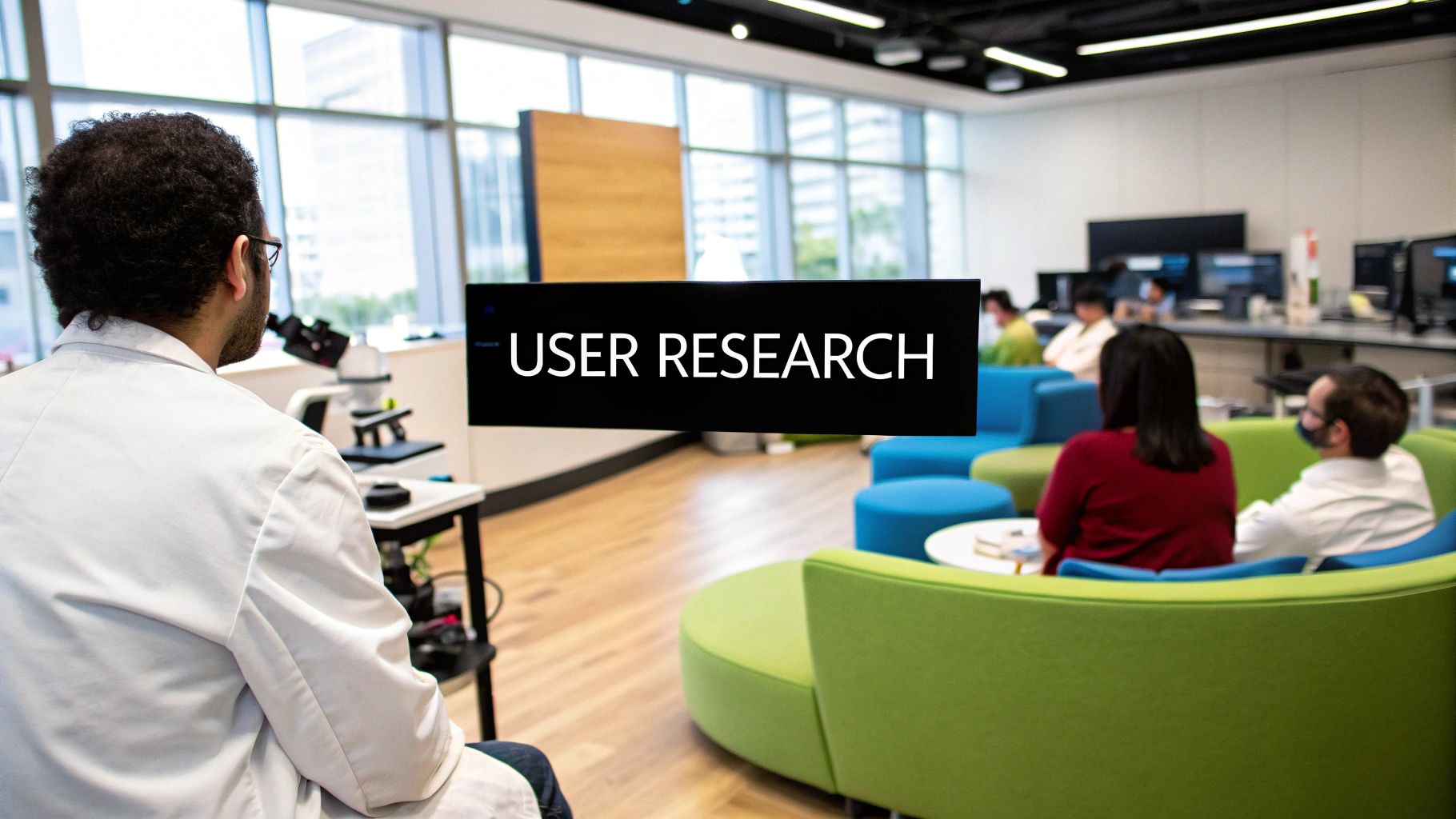
The process generally moves through these phases:
- Empathize: Get out there and talk to your learners. Observe them, interview them, and truly understand their experience.
- Define: Based on your research, nail down the core problem you're actually trying to solve—from their point of view.
- Ideate: Go wild brainstorming solutions. No idea is too crazy at this stage.
- Prototype: Create cheap, simple mockups of your best ideas.
- Test: Put those prototypes in front of real learners, watch what happens, and listen to their feedback.
Let's say a tech company sees its new junior developers are struggling to apply their academic knowledge to real-world coding challenges. Instead of jumping to build a generic "Advanced Coding" course, a Design Thinking approach would start by interviewing those developers. You’d sit with them, map out their daily workflow, and pinpoint the exact moments of frustration before ever proposing a solution.
This deep dive into their reality ensures you’re solving the root cause of the problem, not just patching over the symptoms. It’s the best framework for true innovation, especially when the path forward isn't obvious.
How to Design for True Engagement
 Image
Image
Principles and frameworks give you a solid foundation, but real engagement is where the learning actually sticks. Think of engagement as the lifeblood of any course. Without it, even the most beautifully designed content is just static on a screen. Our job is to pull learners out of passive consumption and into an active, memorable experience that genuinely sparks their curiosity.
This means we have to go way beyond just dumping information on them. We need to build an environment where people feel motivated, connected, and even a little emotionally invested in what they're learning. Luckily, learning experience design has a few powerful techniques up its sleeve to make that happen.
Foster Motivation with Gamification
Gamification gets a bad rap sometimes, but it’s so much more than just slapping on points and badges. When you do it right, you’re tapping into a very human desire for achievement, a bit of friendly competition, and recognition for hard work. It’s about using game mechanics to make learning feel more compelling and give people instant, satisfying feedback.
Imagine adding a fun, competitive layer to your course. Leaderboards can stir up some friendly rivalry, and watching your points rack up as you finish modules gives you a clear shot of accomplishment. It’s not about turning your course into a full-blown video game; it’s about making learning feel less like a chore and more like a challenge you actually want to beat.
Some effective gamification tactics include:
- Points and Rewards: Give out points for completing lessons or quizzes. These can be purely for bragging rights or even unlock bonus content.
- Leaderboards: A simple scoreboard shows learners where they stand among their peers, which is a huge motivator for many.
- Badges and Achievements: Award digital badges for mastering a tough concept or completing a major section. It’s a tangible way to recognize milestones.
Make Learning Digestible with Microlearning
Let's be real: attention spans are short. People are busy. That's where microlearning comes in. It’s all about breaking down big topics into small, focused, bite-sized pieces. So instead of a marathon one-hour video lecture, you create a series of five-minute clips, quick-read articles, or fast, interactive quizzes.
This approach respects the learner's time and, more importantly, it actually helps them remember more. By tackling just one key idea at a time, microlearning prevents that feeling of being totally overwhelmed and makes it much easier for the brain to process and lock in new information. This is why it’s taking the corporate training world by storm.
The corporate e-learning market is set to grow by a massive USD 131.01 billion between 2025 and 2029. That growth is heavily driven by flexible, high-retention methods just like microlearning. You can get more details on this trend's impact on corporate training.
Connect Learners Through Social Learning
Learning often feels like a solo mission, but it absolutely doesn't have to be. Social learning focuses on building a community where people can toss around ideas, ask questions, and tackle problems together. This creates an incredible support system and exposes everyone to different perspectives they’d never find on their own.
Things like discussion forums, group projects, and peer review sessions get people talking and turn learning into a shared journey. For IT pros, platforms like HydraNode can even simulate the kind of collaborative troubleshooting that’s essential on the job. Our AI-powered exam prep, for instance, can be a powerful supplement to your studies by connecting you with a network of peers. When people can teach and learn from each other, the knowledge sinks in so much deeper.
Create Emotional Resonance Through Storytelling
Facts are easy to forget. Stories stick with you. Storytelling is one of the most powerful tools in our LXD toolkit because it forges an emotional link to the material. When you wrap information in a narrative—complete with characters, a challenge, and a resolution—you make abstract concepts feel real and relatable.
For example, don't just list the steps of a cybersecurity protocol. Frame it as a story: an analyst is racing against the clock to stop a cyberattack in progress. This context gives learners a powerful "why" behind the "what," which does wonders for both engagement and long-term retention.
Putting LXD to Work for IT Certification Success
 Image
Alright, let's pull this out of the theoretical clouds and see how it works on the ground. We can apply learning experience design to a challenge that almost every IT professional knows well: the pressure cooker of preparing for a major certification exam.
Image
Alright, let's pull this out of the theoretical clouds and see how it works on the ground. We can apply learning experience design to a challenge that almost every IT professional knows well: the pressure cooker of preparing for a major certification exam.
The material is dense, the stakes are high, and failure can genuinely impact your career. "Studying hard" isn't a strategy; it's a direct path to burnout.
This is exactly where a smart LXD approach can make all the difference. Instead of just grabbing a stack of books and firing up some videos, we can consciously design a complete learning ecosystem. We're not just studying; we're building a structured, manageable, and far more effective journey to the finish line.
Starting with a Personalized Blueprint
Any good learning design starts with knowing your audience—in this case, you. For IT cert prep, this means ditching the generic, one-size-fits-all study guide and creating a plan based on where you are right now.
Before you crack a single book, take a high-quality practice exam. Seriously. The goal isn't to get a passing grade; it's to get data. Think of it as creating a detailed map of your current knowledge, complete with bright spots and—more importantly—clear red flags marking your weak points.
This initial diagnostic becomes the foundation for your entire study plan. Now, instead of wasting precious hours on topics you already know cold, you can focus your energy precisely where it matters most. Your plan becomes a living roadmap, not just a static to-do list.
Building Skills Through Active Practice
Let’s be honest. Reading about network configurations or cloud architecture is one thing. Actually doing it is something else entirely. True learning, the kind that sticks, comes from experience. Passive learning just doesn’t cut it when you need practical skills for the exam and the job.
This is where tools like interactive labs and realistic simulations are invaluable. They give you a sandbox to play in—a safe place to experiment, break things, and figure out how to fix them without any real-world consequences. This kind of hands-on work builds muscle memory and a much deeper understanding than reading ever could.
You can also supercharge this with adaptive quizzing. For example, using an AI exam generator to create targeted quizzes on only your weakest areas turns rote memorization into an active, data-driven process of shoring up your knowledge.
An effective study process is an active one. It moves the learner from being a passive consumer of information to an active participant in their own skill development, which is proven to boost long-term retention and real-world application.
Tapping into the Power of Community
Studying for a big exam can feel like a lonely road, but it really doesn't have to be. Bringing a social element into your prep can provide the motivation, support, and different perspectives you need to push through the tough spots. It turns a solo grind into a team mission.
A great way to do this is by creating or joining a study group on a platform like Discord or Slack. In these communities, you can:
- Explain concepts to each other: Trying to teach a topic is one of the single best ways to find out if you really understand it.
- Share resources and tips: Someone else has probably already found that perfect YouTube video or blog post you’ve been searching for.
- Hold each other accountable: A little peer pressure and encouragement can be exactly what you need to stay on track when your own motivation dips.
This peer-to-peer connection adds a vital human touch to the learning journey. If you're curious about how this can work in a more structured setting, check out how we integrated community insights while building our CompTIA A+ Core 1 exam guide. It’s a perfect example of how collaborative knowledge can be a total game-changer.
Common Questions About Learning Experience Design
As learning experience design steps into the spotlight in modern training, a lot of questions naturally bubble to the surface. It's a field that pulls from design, psychology, and tech, so it's totally normal if things feel a bit fuzzy at first. Let's clear the air and tackle some of the most common questions people have.
LXD vs. Instructional Design: What’s the Difference?
This is easily the question I hear most often, and the distinction really gets to the heart of the matter.
Traditionally, Instructional Design (ID) is all about the content. Its main job is to figure out what information needs to be taught and then organize it in the most logical, step-by-step way possible. Think of it as building the lesson plan or the curriculum itself.
Learning Experience Design (LXD), on the other hand, zooms out to focus on the person doing the learning. It starts by asking questions like, "Who is this person? What drives them? What are their frustrations?" From there, it aims to build an entire experience that’s not just effective, but also engaging and deeply human.
To put it simply: ID builds the what, and LXD designs the how and the why.
What Skills Do I Need for a Career in LXD?
Jumping into an LXD career isn't just about memorizing learning theories. It demands a pretty unique mix of skills, turning you into a sort of hybrid problem-solver who can wear multiple hats.
You'll need to be good at:
- Empathy and User Research: This is non-negotiable. You have to be able to genuinely step into a learner's shoes, which means getting good at things like interviews, observation, and understanding their day-to-day world.
- Design Thinking: This is your process. It’s an iterative, creative way to solve problems that always puts the learner's feedback at the center of every decision.
- Visual and Interaction Design: You don't have to be a graphic design guru, but you do need a solid grasp of what makes an interface intuitive and visually clean.
- Storytelling: People remember stories, not bullet points. The ability to weave a narrative through the learning material makes it stick and connect on an emotional level.
How Do I Measure Success Beyond Completion Rates?
For years, the gold standard was simply "Did they finish the course?" In LXD, that's just scratching the surface. Real success is about impact—seeing a real change in what people can do.
The most meaningful metrics in learning experience design aren't about consumption, but about application. Success is measured by observing improved performance, increased confidence, and a tangible change in how learners approach their work.
Instead of just looking at completion rates, we track metrics like:
- Skill Application: Are people actually using what they learned back on the job? You can measure this with practical assessments or by looking at performance data.
- Learner Engagement: Where are learners spending the most time? Which features are they gravitating toward? This tells you what's really working.
- Qualitative Feedback: What are learners saying? Surveys and one-on-one interviews can give you insights that raw data never will.
This kind of data-first approach is crucial for proving value and is exactly how we approach learning with our AI-driven study tools for CompTIA Security+.